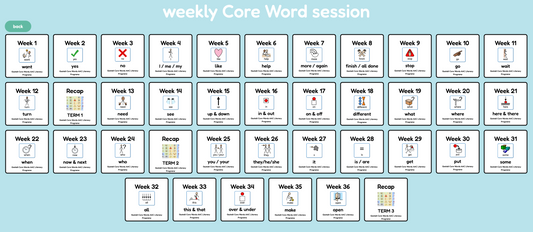
Hello and welcome to the last recap of year one of my Core Word Programme! Congratulations on getting here, this is an important milestone! Over the past term, we’ve continued to build on those strong foundations, introducing and practising a new set of functional words that support deeper engagement, growing independence, and more confident communication.
My Core Word Programme supports literacy development in a way that aligns with how many Gestalt Language Processors and autistic children naturally learn. Using engaging games, playful activities, sensory stories, and interactive experiences, we model and reinforce these meaningful core words, helping learners build the confidence and skills they need to communicate effectively.

Below is a quick refresher on each of our focus words, along with links to revisit previous blogs and videos. You can view the Term 1 recap blog post here, and term 2 recap here.
25. You & Your
“You” is a word that helps us talk directly to others. It is used to get someone’s attention, give instructions, make choices, and build social connections. Learning to use “you” supports communication in everyday interactions and helps children become more aware of others around them.
Read the full blog post here, and watch the YouTube video & RISE session by clicking the thumbnails below.


26. They/he/she
These words help our learners talk about other people, describe who is doing something, and build clearer, more meaningful sentences. Being able to use these pronouns supports social interaction, storytelling, and understanding others.
Read the full blog post here and watch the Youtube video & RISE session by clicking the thumbnails below.


27. It
“It” is a useful word that we use all the time to talk about things around us. It helps children refer to objects, actions, or situations without needing to name them every time. For example, we might say “It is big,” “I like it,” or “Where is it?”
Learning to use “it” also supports children’s language development by helping them build longer, more flexible sentences. It encourages them to communicate more efficiently, especially when they may not yet know or be able to say the name of an object.
Read the full blog post here and watch the Youtube video & RISE session by clicking the thumbnails below.


28. Is/Are
These are important helping words that allow our learners to build longer sentences and describe what is happening around them. Words like “is” and “are” support children in combining ideas, for example: “It is big” or “They are playing.”
By learning to use these words, students can begin to express more detailed thoughts, talk about people and objects, and develop their understanding of grammar in a natural, functional way.
Read the full blog post here and watch the Youtube video & RISE session by clicking the thumbnails below.


29. Get
This is a highly useful and flexible word that can be used in many different situations throughout the day. Children can use “get” to request (“get ball”), to talk about actions (“go get it”), or to describe changes (“get big”).
By learning to use “get,” students can communicate their wants and needs more clearly, as well as describe what is happening around them.
Read the full blog post here and watch the Youtube video & RISE session by clicking the thumbnails below.


30. Put
This week, we are focussing on the word "put". This simple, powerful word can help our learners give directions, organise their environments and take part in every day routines. These are all important skills for building independence and communication.
Read the full blog post here and watch the Youtube video & RISE session by clicking the thumbnails below.


31. Some
This week’s focus word is “some.” It’s a flexible and useful word that helps children request, make choices, and talk about quantity - all key parts of developing communication.
Read the full blog post here and watch the Youtube video & RISE session by clicking the thumbnails below.


32. All
This is an important word that helps learners talk about quantity, completion, and inclusion. Children can use “all” in many different ways, such as “all gone,” “all done,” “all together,” or “I want all of it.”
Read the full blog post here and watch the Youtube video & RISE session by clicking the thumbnails below.


33. This & That
These important words help learners identify, describe, and talk about people, objects, and activities in their environment.
Learning to use “this” and “that” helps students make choices, direct attention, ask for items, and share their thoughts with others.
Read the full blog post here and watch the Youtube video & RISE session by clicking the thumbnails below.


34. Over & Under
These words help learners talk about where things are and describe the position or movement of objects. Children can use “under” and “over” in everyday situations, such as “The ball is under the table” or “Jump over the line.”
Learning to use these words supports the development of spatial concepts and helps students give and understand directions, describe their environment, and participate in a wide range of activities.
Read the full blog post here and watch the Youtube video & RISE session by clicking the thumbnails below.


35. Make
Make” is a useful word that children can use all day long when they are creating, building, doing, or helping something happen. We might hear or model phrases such as “make a tower,” “make it go,” “make a picture,” or “make more.”
Learning the word “make” gives our learners another way to share their ideas, join in activities, and talk about what they want to do. It can be used during play, arts and crafts, cooking, construction, and many other everyday experiences.
Read the full blog post here and watch the Youtube video & RISE session by clicking the thumbnails below.


36. Open
It’s a motivating and practical word that helps children request access to items, start activities, and engage with the world around them - all important for building independence and purposeful communication.
Read the full blog post here and watch the Youtube video & RISE session by clicking the thumbnails below.


What's next?
This is a perfect time to revisit the activities and strengthen understanding before moving on. Core words grow with repetition, practice, and modelling in routines.
Then, either you start again with year 1 or get started on year 2, depending on your class needs and what you feel would suit best.
The first time I repeated year 1 in year two with great success and this year we felt ready to use year 2 and have seen amazing progression there too. Trust your gut.