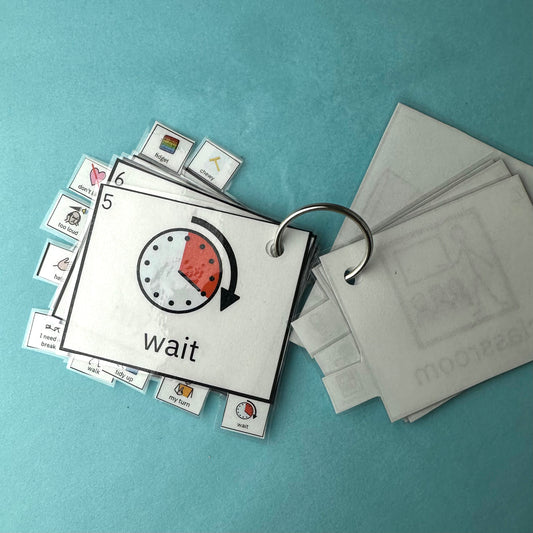
A few people have messaged me recently after being questioned during learning walks or school visits about their use of the Core Word Programme—especially when they’ve said phonics isn’t appropriate for some of their non-speaking or developmentally early learners.
And I get it. It can feel a bit intimidating when someone asks:
“Why aren’t you doing phonics?”
“Why those 40 words?”
“Is this recognised by the government or the EEF?”
So here’s how I would break it down, based on the research, the theory, and the practical results we’re seeing every day in our classrooms.
Why Isn’t Phonics Right for All Learners?
If a child doesn’t yet understand or use spoken language functionally, phonics isn’t the priority. Before a child can link a letter to a sound, they need to understand that communication has purpose. For some of our learners—especially minimally speaking autistic children or those who are gestalt language processors—connection comes before phonics.
Instead, we focus on building:
- Environmental sound awareness
- Symbolic understanding
- Core vocabulary modelling
- Regulated attention and interaction
This builds the foundations for communication and literacy that are appropriate and meaningful.
Gestalt Language processors, for which many autistic learners are, also learn language differently to neurotypical learners. Where our typically developing learners learn sounds first, then words, then phrases, gestalt language processors will do the opposite. They learn whole phrases first, then mitigate those into single words with meaning.
I have more in-depth information about that here: https://sensoryclassroom.org/blogs/sensoryclassroom/gestalt-language-processing-stages
Ultimately, this programme is designed around how our autistic learners learn language and around what motivates them.
Why Were these core words chosen?
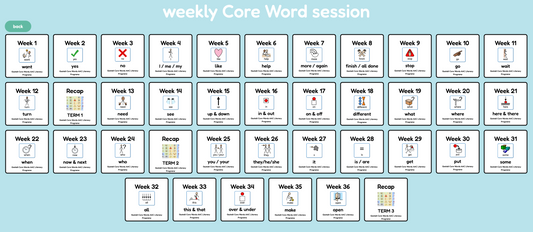
The 40 weeks cover 53 words in my Core Word Programme in the first year. These are drawn from the Dynamic Learning Maps (DLM) First 40 Core Words—a research-informed list created specifically for AAC users and learners with complex needs. These are words that:
- Can be used in a wide range of contexts
- Support spontaneous and meaningful language
- Are frequently used by early communicators across environments
Think words like go, stop, help, more, in, you, like…. Etc
These are the building blocks of real communication—not just naming things, but interacting.
Plus this is only the first year of the programme, in future years we’ll eventually cover all 200 main core words. (High frequency word)
This enables the programme to also be used alongside phonics teaching if appropriate. These words are so often tricky words as they cannot be segmented and blended.
Is this recognised by the EEF or Government?
No—this specific programme is not a government-endorsed or EEF-funded scheme (yet!!). But it is grounded in best practice. It aligns with:
- AAC research and the principles of aided language stimulation
- Universal Design for Learning (UDL)
- EYFS and Engagement Model approaches
- Inclusive curriculum guidance for non-verbal and pre-symbolic learners
And most importantly: it works. It helps learners communicate more, feel heard, and be part of their classroom.
What You Can Say During a Visit or Learning Walk
If you’re questioned, you can confidently say something like:
“For learners who are not yet speaking or who are gestalt language processors, phonics is not developmentally appropriate. We follow a structured Core Word Programme based on the DLM First 40 Core Words. It gives consistent access to functional, high-frequency vocabulary, supports aided language modelling, and is developmentally appropriate for learners working at a 0–4 year stage. This can be used alongside phase 1 phonics if required and suitable. This programme covers, communication, reading, writing, receptive skill for each word over a full academic year. Everything is done for you.”
You can also point them to the programme here: https://sensoryclassroom.org/products/core-word-programme-app
or free trial here: https://sensoryclassroom.org/products/free-trial-core-word-programme
And for those who want to see the theory and references, there’s a full Core Word Manual included with the resource. If you’ve got that printed and ready to hand over—it shows you’re not just guessing, you’re implementing with intention.
Final Thoughts
You’re the expert in your room. You know what your learners need. And if the Core Word Programme is helping them find their voice—stick with it.
If you ever need something to back you up, I’ve got you. Print the manual, point them to the link, or send them here to read this blog.
You’re doing an amazing job by advocating for your learners!
References
Ehri, L. C. (2005). Learning to read words: Theory, findings, and issues. Scientific Studies of Reading, 9(2), 167–188.
Foundational literacy research explaining how sight-word recognition supports fluent reading, especially when phonological decoding is effortful or unreliable.
Nation, K. (2017). Children’s reading difficulties, language, and literacy. Oxford University Press.
Discusses multiple pathways to literacy, highlighting that phonics is not sufficient for all learners, particularly those with language and processing differences.
Ricketts, J., Jones, C. R. G., Happé, F., & Charman, T. (2013). Reading comprehension in autism spectrum disorders: The role of oral language and social functioning. Journal of Autism and Developmental Disorders, 43, 807–816.
Shows that many autistic learners can decode but struggle with meaning, supporting literacy approaches that prioritise vocabulary and comprehension over phonics alone.
Norbury, C. F., et al. (2016). The impact of nonverbal ability on reading and language comprehension in autism. Autism Research, 9(1), 95–109.
Highlights uneven literacy profiles in autistic learners and the need for flexible, meaning-based literacy instruction.
Light, J., & McNaughton, D. (2012). Supporting the communication, language, and literacy development of children with complex communication needs. Topics in Language Disorders, 32(4), 269–288.
Strongly supports core-word and AAC-based literacy approaches, emphasising whole-word recognition and functional language.
Romski, M. A., Sevcik, R. A., Barton-Hulsey, A., & Whitmore, A. S. (2015). Early AAC intervention and language development. Augmentative and Alternative Communication, 31(3), 181–202.
Demonstrates that language-rich AAC and core-word exposure support vocabulary, syntax, and early literacy foundations.
Ganz, J. B., et al. (2012). A meta-analysis of aided AAC systems with individuals with autism spectrum disorders. Journal of Autism and Developmental Disorders, 42, 60–74.
Finds that symbol-based, modelling-led AAC supports broader communication and early literacy skills more effectively than narrow skill-based approaches.
Millar, D. C., Light, J. C., & Schlosser, R. W. (2006). The impact of AAC intervention on speech production. Journal of Speech, Language, and Hearing Research, 49, 248–264.
Supports AAC as a language and literacy support, countering fears that whole-word or symbol-based approaches hinder development.
Erickson, K. A., Hatch, P., & Clendon, S. (2010). Literacy instruction for students with significant disabilities. Paul H. Brookes Publishing.
Seminal text advocating for sight-word, core-word, and meaningful literacy, rather than phonics-driven programmes, for learners with complex needs.
Browder, D. M., Wakeman, S. Y., Spooner, F., Ahlgrim-Delzell, L., & Algozzine, B. (2006). Research on reading instruction for individuals with significant cognitive disabilities. Exceptional Children, 72(4), 392–408.
Evidence supporting whole-word and functional literacy approaches over phonics-only instruction.
Flores, M. M., et al. (2014). Teaching sight words to students with autism spectrum disorder: A meta-analysis. Focus on Autism and Other Developmental Disabilities, 29(2), 79–90.
Shows consistent gains in functional reading using sight-word instruction with autistic learners.
Spector, J. E. (2011). Sight word instruction for students with autism: A review of the literature. Education and Training in Autism and Developmental Disabilities.
Supports sight-word approaches as accessible and effective, especially for learners with limited phonological awareness.
Light, J., & McNaughton, D. (2014). Communicative competence for individuals who require AAC. Augmentative and Alternative Communication, 30(1), 1–18.
Frames literacy as part of communicative competence, aligning with core-word literacy rather than isolated decoding skills.
Snowling, M. J., & Hulme, C. (2012). Interventions for children’s language and literacy difficulties. International Journal of Language & Communication Disorders, 47(1), 27–34.
Acknowledges that phonics is not universally effective, especially when oral language and meaning-making are primary barriers.
ASHA (American Speech-Language-Hearing Association). (n.d.). Augmentative and Alternative Communication Practice Portal.
Professional guidance supporting core vocabulary, modelling, and meaningful literacy experiences, particularly for AAC users and autistic learners.