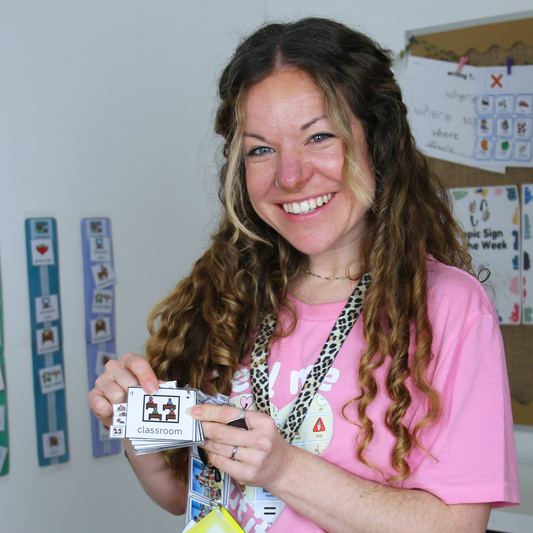
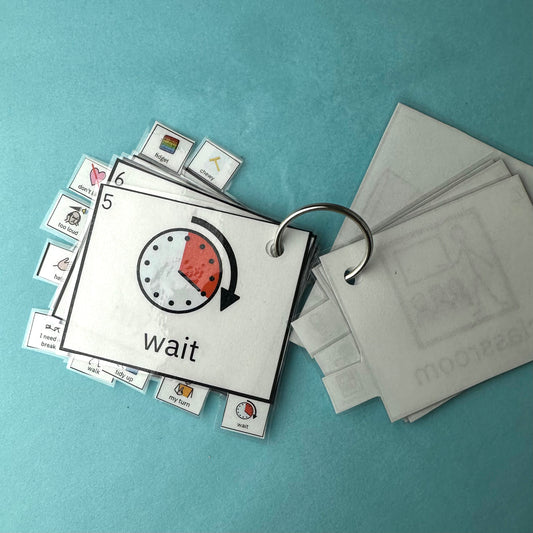
AAC (Augmentative and Alternative Communication) is more than just a device or symbol board. It’s a lifeline to independence, self-expression, relationships and learning — especially for autistic, disabled, or minimally speaking learners.
But if you’ve ever asked, “Am I doing this right?”, you’re not alone.
Supporting AAC users can feel overwhelming, especially when a child isn’t instantly engaging with their system. The truth is, progress takes time — and consistency. But the good news? You don’t have to be a speech therapist to make a difference.
What actually is AAC?
AAC means any form of communication that isn’t spoken aloud — from gestures and symbols to high-tech devices like Grid, TD Snap or LAMP. Some children use AAC alongside speech (augmentative), while others use it as their main form of expression (alternative).
But having access to a device isn’t the same as knowing how to use it. That’s where you come in.
Teaching AAC: 5 Things That Make All the Difference
1. Assume competence
AAC learners are often far more capable than we assume — the issue isn’t what they can understand or think, but how much time, practice, and support they need to express it. The gap between what a learner is thinking and what they’re able to say is often massive. Presume they have something to say — always.
here is a blog about what AAC app to choose
2. Model language without pressure
One of the most powerful AAC strategies is modelling. That means you use the AAC device to speak - even if the child doesn't respond. Every time you model a word, you're helping them learn where it is, what it mean and how to use it.
💡 Top tip: Aim for 4 comments for every 1 question. Instead of “What do you want?”, try “I wonder what you’ll choose” + “I like that one too” + “I’m going to press go” + “Let’s see what happens next”.
3. Focus on why and when to communicate- not just HOW
Communication isn’t just about requesting. Children need AAC for:
- commenting
- saying no
- expressing feelings
- protesting
- making choices
- telling stories
- asking for help
If the only button they learn is “more,” we’re missing the bigger picture. True AAC learning is about offering real, meaningful opportunities to communicate — across the whole day, with different people and in different settings.
4. Build vocabulary in two layers: core and fringe
The core vs fringe concept:
- Core words: general words used every day (go, stop, like, help)
- Fringe words: specific to interests or activities (dinosaur, swing, biscuits)
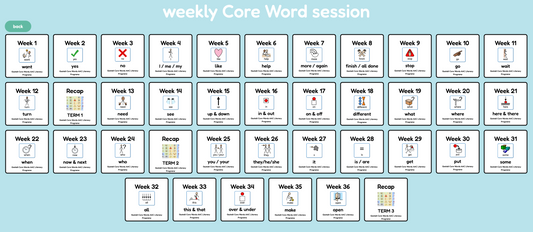
Core words are where language begins. They make up 80% of what we say. That’s why the Core Word Programme was created — to focus your AAC practice on one core word each week, with activities, visuals and videos to support both school and home learning.
You can explore the full programme here: https://sensoryclassroom.org/products/core-word-of-the-week-programme-full-academic-year
Or try Week 1 for free: https://sensoryclassroom.org/collections/sensory-stories/speech
5. Make AAC available and part of daily life
Children need:
- frequent opportunities to use AAC in real situations
- modelling across all communication functions (not just requesting)
- trained and confident adults who use AAC alongside them
- patience, flexibility, and support from everyone
Objects of reference printables can be found on my storage drive, click here to watch a video all about them!
There are also loads of coreboards and training for AAC on my storage drive.
I have lots of tabbed symbol options to purchase here, using different symbol languages
and lots of Widgit Symbol sets here
Want the Full Core Word Programme?
👉 The Core Word Programme includes:
✔️ A weekly lesson structure to teach AAC
✔️ AAC Coreboards and printable visuals
✔️ Planning templates and data tracking
✔️ Activity suggestions, songs, TV clips & more
✔️ Designed specifically for AAC users who are gestalt processors
Whether you’re a teacher, TA, SALT, SENCO or parent — this gives you the tools to support spontaneous, functional language that grows with the learner.
Final Thought:
You don’t have to teach every word.
You just need to teach enough words, often enough, in real contexts.
The rest? It builds from there.
References:
American Speech-Language-Hearing Association (ASHA). (n.d.). Augmentative and Alternative Communication (AAC). ASHA Practice Portal.
Used widely as an evidence-informed professional guidance source on AAC assessment, intervention, modelling, and partner training.
Beukelman, D. R., & Mirenda, P. (2013). Augmentative and Alternative Communication: Supporting Children and Adults with Complex Communication Needs (4th ed.). Paul H. Brookes Publishing.
Foundational textbook covering AAC theory, assessment, intervention, and evidence-based practice.
Crowe, B., Trembath, D., & Iacono, T. (2021). Augmentative and alternative communication for children: A mega-review of the literature. Augmentative and Alternative Communication, 37(3), 152–165.
A synthesis of multiple systematic reviews examining the effectiveness of aided AAC interventions.
Drager, K. D. R., Light, J. C., Curran-Speltz, J., Fallon, K. A., & Jeffries, L. Z. (2006). The performance of typically developing 2½-year-olds on dynamic display AAC systems. Augmentative and Alternative Communication, 22(2), 100–112.
Frequently cited in discussions around access, modelling, and early AAC use.
Iacono, T., Trembath, D., & Erickson, S. (2016). The role of augmentative and alternative communication for children with autism: Current status and future trends. Developmental Neurorehabilitation, 19(3), 163–171.
A narrative review summarising AAC outcomes and directions for practice with autistic learners.
Light, J., & McNaughton, D. (2014). Communicative competence for individuals who require augmentative and alternative communication: A new definition for a new era of communication? Augmentative and Alternative Communication, 30(1), 1–18.
Seminal paper redefining communicative competence beyond requesting and speech output.
Millar, D. C., Light, J. C., & Schlosser, R. W. (2006). The impact of augmentative and alternative communication intervention on the speech production of individuals with developmental disabilities: A research review. Journal of Speech, Language, and Hearing Research, 49(2), 248–264.
Widely cited evidence countering the myth that AAC prevents speech development.
Romski, M. A., & Sevcik, R. A. (2005). Augmentative communication and early intervention: Myths and realities. Infants & Young Children, 18(3), 174–185.
A key paper addressing common misconceptions about AAC and early use.
Romski, M. A., Sevcik, R. A., Barton-Hulsey, A., & Whitmore, A. S. (2015). Early intervention and AAC: What a difference 30 years makes. Augmentative and Alternative Communication, 31(3), 181–202.
Evidence supporting early AAC introduction and partner involvement.
Schlosser, R. W., & Lee, D. L. (2000). Promoting generalization and maintenance in AAC intervention: A meta-analysis of 20 years of effectiveness research. Augmentative and Alternative Communication, 16(4), 208–226.
Classic meta-analysis focusing on outcomes, generalisation, and instructional variables.
Spencer, T. D. (2025). Augmentative and alternative communication interventions that promote commenting in individuals with complex communication needs: A systematic review. Augmentative and Alternative Communication.
Recent review highlighting AAC use beyond requesting, including commenting and social communication.
White, E. N., Ayres, K. M., Snyder, S. K., & Cagliani, R. R. (2021). Augmentative and alternative communication and speech development in children with autism spectrum disorder: A systematic review. Journal of Autism and Developmental Disorders, 51(11), 4012–4032.
Examines relationships between AAC use and speech development outcomes.
Carnett, A., Laubscher, E., & Soto, G. (2023). A systematic review of AAC interventions targeting core vocabulary for individuals with autism spectrum disorder. Journal of Autism and Developmental Disorders.
Provides evidence for the use of core vocabulary approaches in AAC.
Dumitru, C., et al. (2025). Assistive technology and augmentative and alternative communication for language development in inclusive classrooms: A systematic review. Education Sciences.
Explores AAC implementation in educational settings.
International Society for Augmentative and Alternative Communication (ISAAC). (n.d.). AAC evidence, policy, and position statements.
Professional organisation supporting evidence-based AAC practice and communication rights.